Introduction
This is how I found two Remote Code Execution (RCE) vulnerabilities on a bug bounty program target by combining Shodan reconnaissance with default credential testing on an exposed SAP Commerce admin panel.
Reconnaissance
I started by searching for the target's infrastructure on Shodan using the SSL certificate:
ssl:target.com
This returned several IP addresses associated with the target. One of them caught my attention: 40.117.x.x.x
Discovery — SAP Commerce Admin Panel
Running a directory scan against the IP, I found an interesting endpoint:
/hac/login/
This is the HAC (Hybris Administration Console) — the default admin panel for SAP Commerce (formerly SAP Hybris). This panel should never be exposed to the internet.

Default Credentials
I tried the well-known default credentials for SAP Commerce HAC:
Username: admin
Password: nimda
It worked. I was logged into the administration console with full access.
Remote Code Execution
The HAC admin panel includes a Scripting Console that allows executing Groovy scripts directly on the server. This is by design — it's meant for administrators to run maintenance tasks.
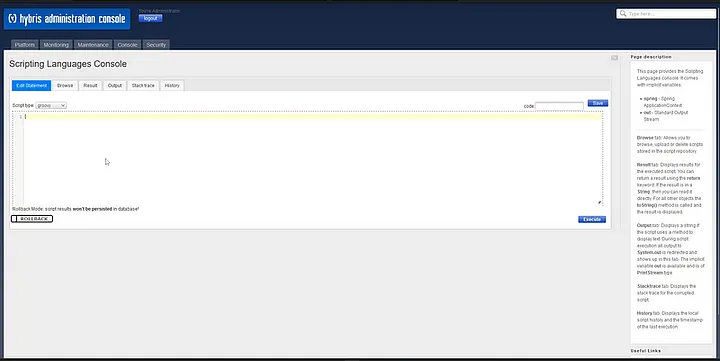
I used this functionality to execute system commands on the server, achieving Remote Code Execution.
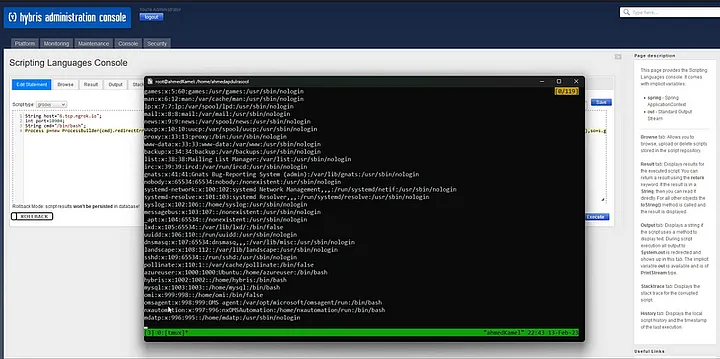
Impact
With RCE on the server, an attacker could:
- Read sensitive files — configuration, database credentials, API keys
- Access internal systems — pivot to other services on the network
- Modify application data — tamper with the e-commerce platform
- Deploy backdoors — maintain persistent access
Both RCE findings were on different servers belonging to the same program, doubling the impact.
Key Takeaways
- Shodan is incredibly powerful for recon — Search by SSL certificate, organization name, or specific headers to find hidden infrastructure.
- Always test default credentials — Especially on admin panels. SAP Commerce's
admin:nimdais a classic. - Exposed admin panels are critical findings — Even without default creds, an internet-facing admin panel is a serious misconfiguration.
- Check for scripting consoles — Many enterprise platforms (SAP, Jenkins, JMX) have built-in code execution features.
TL;DR
Shodan + Default Creds + SAP Commerce HAC Scripting Console = RCE
Originally published on Medium